I’m not running any Group sessions at the moment. If you’ve got questions, please use the general enquiry form HERE
What is Group Trauma Therapy and how might it help me?
The “Sometimes, Trauma..” Group has been designed for those who are recovering from various traumas. It may be complex historic childhood trauma (neglect, physical, emotional, sexual or religious abuse, attachment issues), or difficult recent traumas – or a combination of both. This information is designed to help you decide if this group is for you. There is some information below about how trauma works and how these groups aim to treat the symptoms therapeutically. There is also specific information about where/when our groups take place at the bottom of the page.
The application form for Group Trauma Therapy can be found HERE.
New Understandings
What we know about the impact of trauma has grown exponentially over the past 30 years. In the past trauma was often unseen, sometimes unhelpfully labelled. In some cases, sufferers were written off as “weak” – people who couldn’t cope with modern life. We now know that the impact of trauma is diagnosable and treatable.
Trauma changes your brain and stays locked in the body. Unless and until it is properly processed, it comes out in our behaviours and coping strategies – and victims of Trauma often see these coping mechanisms as “personality defects”, further compounding shame they might be carrying.
The Brain
In traumatised responses, the “amygdala” (the smoke alarm) becomes hypersensitive (even getting bigger!); memories don’t get filed away properly by the hippocampus – which marks events in the mental filing cabinet as “over and finished”.

Post-Traumatic Stress Disorder (PTSD), or Complex Post-Traumatic Stress Disorder (CPTSD), do not happen to everyone who experiences traumatic events, but this does happen in many cases, especially if you have had other difficulties in your background and upbringing or are not supported in recovery at the time.
The brain changes that occur from these experiences are also more common if during the event(s) you were in a position where you were powerless, immobilised or physically unable to do anything to help get yourself to safety. Coming to feel and create safety is an incredibly important part of recovery.
Meaning Making
Traumas, especially those from early childhood, also change how we see ourselves – the “story” we have told ourselves about what happened is often interlinked with symptoms and experiences. We can hold debilitating beliefs about what happened, even when we consciously know they aren’t true: “If I had fought back, it wouldn’t have happened”. “It happened because I am weak”, “I deserved it, because I am bad”. These beliefs can change how we see the entire world, as well as affect our capacity for self-compassion. Through therapy, changing the meanings we have held can directly help with the way we carry trauma.
The Body
Your memories are encoded in the body – which is why in the group therapy we must invite your body to be part of the solution. The body is still primed for danger, even though that danger has passed. This might be in a “feeling” flashback – a sense of desperation, shame, despair or loathing. This might be in your chronic hypervigilance or sense of danger. Or it could be that you find yourself numbing: feeling a tightness in the chest or jaw, feeling dizzy or experiencing pain that cannot be easily explained medically.
Sometimes people also get physical impulses or movements trapped in the body: frozen states, the impulse to run or get out, violence towards yourself – or being unable to get out of bed and face the world.
Learning to recognise what is happening in our own bodies will form a central part of the group work (in a gentle and non-awkward way!).

Symptoms/Coping Behaviours
Other symptoms, or survival strategies that end up harming us might include:
- Self-injury, starvation, bingeing and purging to induce numbing and increase energy
- Powerful suicidal thoughts and impulses to control to combat the feeling of helplessness
- High risk behaviour to activate the adrenaline response in your body
- Re-enactment behaviour: a way of unconsciously remembering that keeps the event memories in their place, but which can expose you to a lot of danger
- Taking care of others to combat a sense of worthlessness
- Using addictive substances to help numb hyperarousal systems or obsessive thinking – or to energise you and give you a feeling of power. Addictions/Compulsivity in the form of substances, food or exercise are always a way to try and function and feel safer in the world.
Recognising our coping strategies and replacing the unhelpful ones with more directed/safer activities will also be part of the group’s journey.
Other ways the group might help in treating the impact of Trauma – The Trauma Toolkit
The initial goal is firstly to calm the amygdala, to help people to regain a sense of control and (potentially, but with great sensitivity and safety) to look at, and process the memories that emerge in flashbacks or nightmares/intrusive thoughts form.
The group will work mostly within Phase One of the model below, though some Phase Two work may also take place. This model was developed by Judith Herman (Trauma and Recovery (1992) Basic Books);
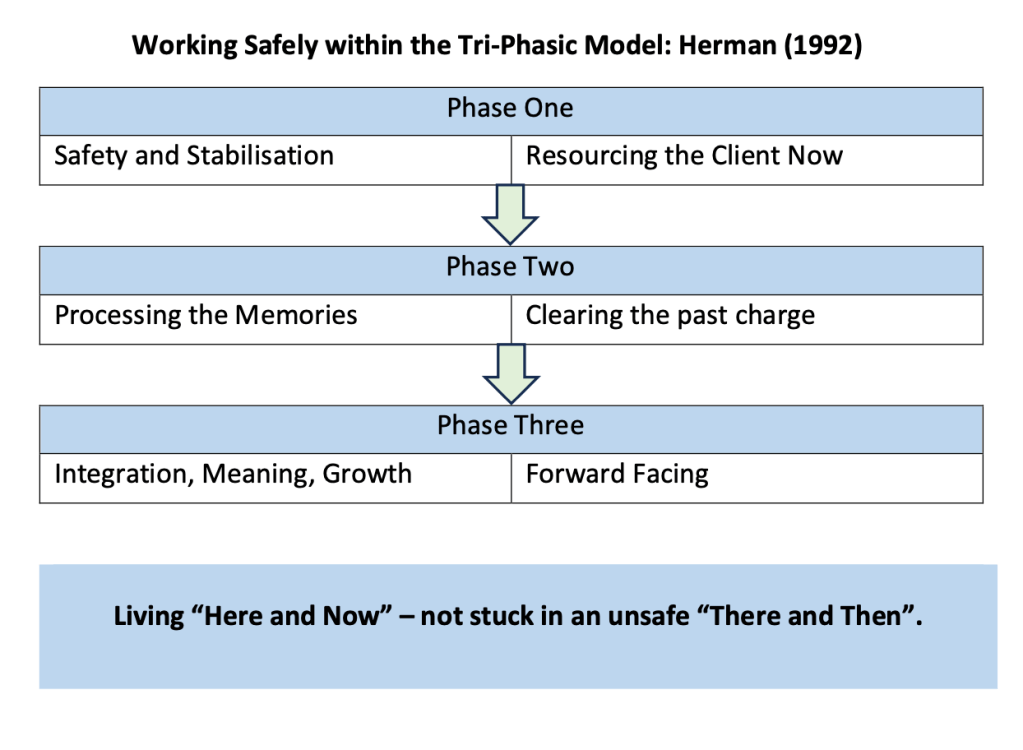

In Phase One we work consciously using a combination of Psychoeducation – knowing what happens in the body and brain, being able to see your coping strategies as symptoms, practising how to stay safe in your body.
Also by using Mindfulness tools to bring you into the “here and now” and safety, rather than getting pulled back to what has happened. This stage can take a while, depending on what has happened to you.


Other tools in Phase One will incorporate learning about Triggers, looking at different parts of yourself that are active now, (the Distressed parts and the Functioning ones), to help grow your coping skills (this is called the Structural Dissociation (Parts) Model) or Journaling, writing an Epilogue to your trauma, finding ways of recognising that you have survived.
IIn Phase One and Two we may also use aspects of the following:
- Cognitive Processing Therapy (CPT) – Helpful for those who are “thinkers” and like information top down from brain to body.
- Emotional Freedom Technique (EFT) – Based on acupuncture meridians, this soothing and gentle “tapping” treatment helps to shift what is blocked up in the body and the beliefs that are stuck with it. It is good for those who let information in “bottom up, from body to brain”.
- Narrative Exposure Therapy (NET) and Image Reprocessing and Rescripting Therapy (IRRT) We can use aspects of these two therapy types to help create a new narrative of the trauma in which you can emerge as a victor.

Practical Group Details and Availability
- Groups will be one and half hours, with the first 45 minutes for check-in/group process, a break and the second 30 minute part for psychoeducation around a specific trauma-informed topic.
- Online Group: numbers are kept low and limited to 7. In-Person Groups (when available) will be up to 10.
- The Online Trauma Group is from 6.45pm to 8.15pm on Mondays, running during term time only.
- If you are interested in an in-person group for Devon or Bristol, please get in touch.
The application form for Group Trauma Therapy can be found HERE.
 Sometimes, Trauma...